
Get the results you seek while building the bond you both deserve.
A Mindset For Success
It is imperative that you decide what type of dog guardian you will be when it comes to teaching your dog.
Will you start from a place of trust and build understanding, clarity, and respect for each other? Or will you use fear, aversion, and force to achieve the behaviors you want from your dog? I highly discourage the latter.
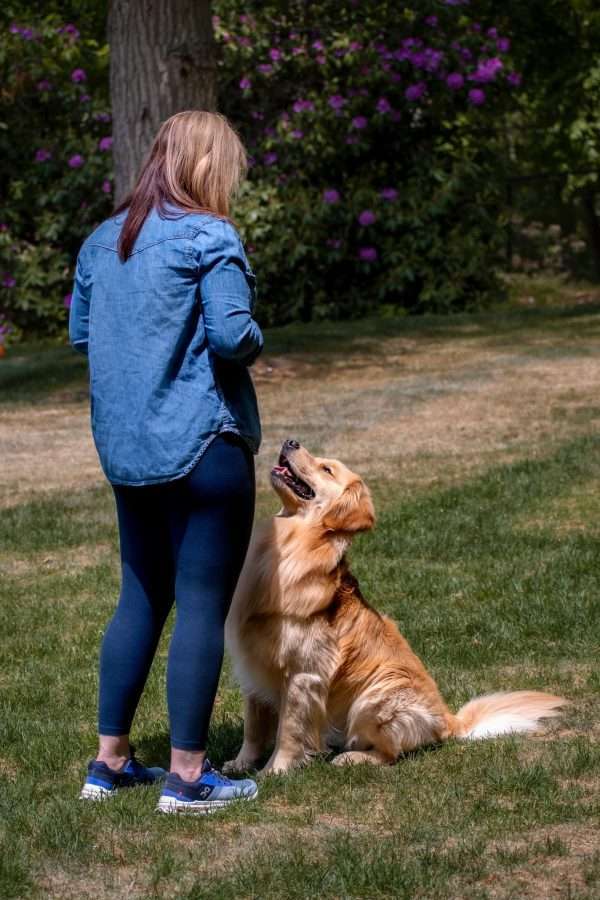
In my opinion, you should approach teaching your dog from the mindset of, “I’ll show my dog what I’d like him to do when I say this cue word and reward him when he gets it.” It’s really that simple. Just keep in mind that simple doesn’t necessarily mean quick.
It’s up to you to learn timing, anchoring, and body language in order to make the cues clear to your dog. This journey of guiding your dog to the goals you have set requires patience and understanding from your end.
This approach focuses on:
- Teaching and learning
- Rewarding success
- Building a partnership with your dog
The energy of this mindset builds confidence in your dog (and your teaching skills), deepens your relationship, and results in the behaviors you seek.
Avoid The Approach, “Do This or Else Something Bad Will Happen”.
This approach:
- Weakens your bond with your dog
- Induces fear and uncertainty
- This can result in negative behaviors such as avoidance, aggression, and unwanted submissive behaviors.
Dogs Are Not Stubborn
Dog guardians will often describe their dogs as “stubborn”. This characterization implies their dog is not doing as asked just to be difficult. This creates a combative stance in the teaching approach.
Dogs don’t actually do things to be “stubborn”. This is a common example of anthropomorphism amongst dog guardians. If your dog isn’t doing as you ask, the likely reason is that he doesn’t understand your request. It’s more a lack in your teaching rather than a lack in your dog’s teachability.
Another reason may be he is afraid for some reason. For example, you may have unintentionally caused fear through your body language when you became frustrated during a teaching session. I, myself, have made this mistake. I had a dog named Brody who was a submissive pee-er and I would become tense before he would actually pee. I realized I was making it worse and had to get my emotions in check if I was going to help him and adjust this behavior.
Another reason is your dog may have forgotten what the cue means. This could happen because you haven’t been consistently reinforcing this particular cue. Dogs need reminders of your expectations associated with cues. If your dog starts coming on recall on the second or third cue instead of the first then it’s time to backtrack and remind him of your expectations.
Your dog always wants to please you, he just doesn’t always know exactly what that should look like.
Dogs Do Not Plot Revenge
Dog guardians will also describe their dogs as “spiteful”. This characterization implies their dog is doing something vindictive.
Dogs live in the present moment always. They don’t have the capacity to think about the past and then plan sweet revenge for the future. They are definitely not peeing on your bed to get back at you for leaving them.
They are acting out either from fear, confusion, anxiety, habit, or other causes. It’s up to you to be the detective to figure out the root cause in order to shape the behavior.
 Commands Vs Cues
Commands are about the human and not the dog. A command is… do this or else something bad will happen. Ordering your dog breaks him down as opposed to guiding builds him up.
A cue is a signal that you are making a request. Cues are part of a style of communication that emphasizes cooperation between two partners. There’s a big difference.
When it comes to teaching your dog it’s important to remember you are establishing communication and building a partnership.
You are building a language between you and your dog and partnering in a conversation. You and your dog naturally speak different languages. Through simple sounds and body language, you are able to communicate across your species. This is pretty awesome if you just take a moment to think about. Consider this next time you feel frustration that your dog is not behaving the way you expect him to…
What It Means To Use Positive Reinforcement
Positive reinforcement-type teaching uses rewards such as treats, praise, toys, etc. to achieve desired behaviors. The reward makes them more likely to repeat the behavior, thus making positive reinforcement one of your most effective tools for shaping or changing your dog’s behavior.
The mode of positive reinforcement that you choose should be defined by your dog’s likes. Consider what makes your dog excited and willing to repeat a behavior. This could be a high-value treat, a favorite toy, a tennis ball, praise, and/or petting.
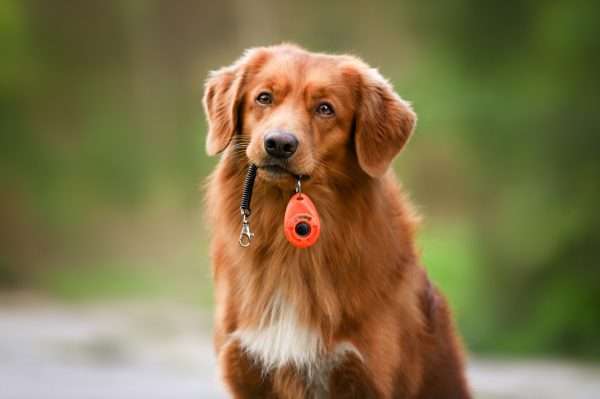
Marker word- Teach your dog to associate a marker word (“yes”, “good”, “that’s it!”) or the sound of a clicker with treats that your dog absolutely loves. When your dog gets a cue correctly, say “Yes!” or click the clicker, then follow immediately with a small but delicious treat. Your enthusiasm and celebration is directly proportional to your dog’s enjoyment of working with you.
Aversive training tools such as prong collars, shock/E-collars, choke collars, etc use positive punishment (adding something uncomfortable or undesirable for the learner to decrease a target behavior) or negative reinforcement (removal of something uncomfortable or undesirable to increase a target behavior) in order to change your dog’s behavior. These methods evoke fear, avoidance, and anxiety in dogs and are the quickest way to lose your dog’s trust. Many rush to these methods because they are frustrated, impatient and want an immediate solution. Consider how your dog feels if he is uncertain of your request and then you shock him in the midst of his feeling confused. Do you think he will immediately think, ” oh she means business now i’ll pay attention”. No! He thinks, “my person just hurt me how do I stop her from doing it again.” That’s not the type of person, guardian or teacher you want to be.
Let’s Sum It Up!
- Approach teaching your dog with patience, understanding, and respect.
- Start by building trust and then make decisions around teaching that will reinforce that trust.
- The goal is not to be perfect, neither for you nor your dog. The goal is to teach your dog how you would like him to behave using clear cues and positive reinforcement in a kind and effective manner.
- Be aware of your dog’s emotional state.
- Be aware of your own emotional state, body language, and teaching techniques. Notice when something you’re doing may be interfering with your dog’s understanding.
- Keep your relationship with your dog as the priority, always.
I think you’re pretty great for taking the time to read my blog and invest this time into you and your dog. Check out my courses to go to the next level of learning with me.
Happy Teaching my friend!