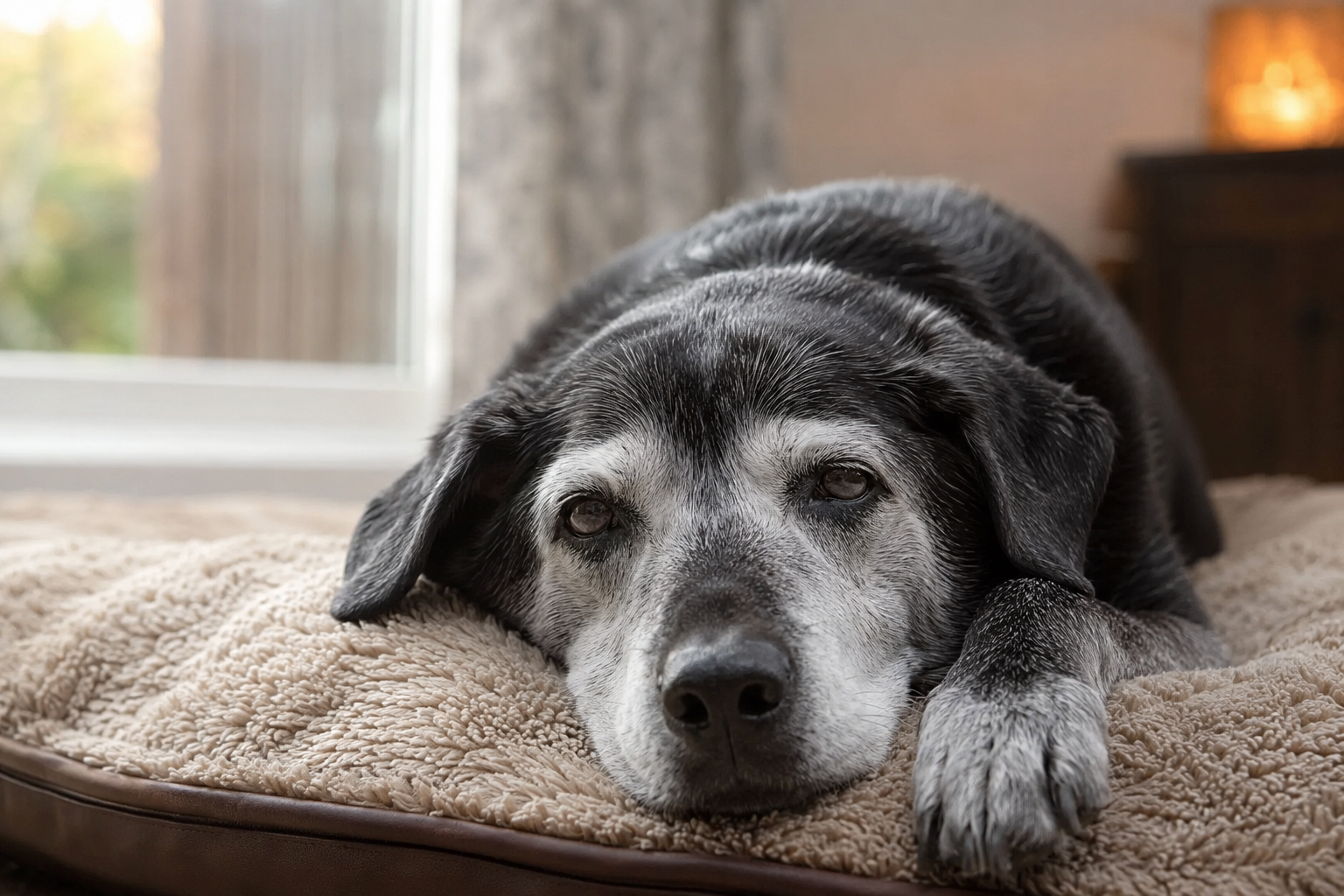

When dogs come through my ER for vomiting, there are many possible causes. It’s a very upsetting symptom for dog guardians to witness in their dogs. No one likes to be nauseous, and we hate to see our dogs go through it. One important thing is the differentiation between nausea and vomiting.
Most of us think of nausea and vomiting as the same problem. They are related, but they are not the same thing, and they are not always treated the same way. A dog can feel miserable and nauseous all day without ever throwing up. Another dog can vomit once, shake it off, and go right back to playing. Knowing which one you are looking at helps you understand how your dog feels, and it helps you and your vet choose the right treatment.
What is the difference?
Nausea is the feeling. It is that queasy, uneasy, “I might be sick” sensation. It can come and go, it can last for hours or days, and it often keeps a dog from eating even when nothing ever comes up.
Vomiting is the action. It is the forceful emptying of the stomach through the mouth, with heaving from the belly. It is a reflex controlled by the vomiting center in the brain.
Nausea often comes before vomiting, but not always. In one study of dogs with vestibular disease (the “old dog” balance problem), every dog showed signs of nausea, but only about a third of them actually vomited (Foth et al., 2021). Nausea can exist on its own, and it deserves treatment on its own.
A quick note on regurgitation. Regurgitation is not vomiting. It is passive. Food or fluid simply slides back up, often undigested and sometimes tube-shaped, with no heaving from the belly. It usually points to a problem with the esophagus rather than the stomach, so tell your vet which one you are seeing.
How to tell if your dog is Nauseous
Dogs can’t tell us they feel sick, but they show us. Watch for:
- Lip licking or smacking
- Drooling more than usual
- Repeated swallowing or gulping
- Yawning when not tired
- Restlessness, pacing, or trouble getting comfortable
- Eating grass or licking the floor, carpet, or walls
- Walking up to the food bowl and turning away
- Hiding, clinginess, or a hunched posture
- Retching or burping
These signs are described consistently by veterinary sources, including PetMD and IDEXX. The dog who is licking his lips and refusing breakfast is often nauseous, even if he never vomits.
What causes each
Causes that are more often nausea than vomiting:
- Motion sickness, especially in puppies and young dogs
- Vestibular disease, where the inner ear balance system is off and the world feels like it is spinning
- Kidney disease, as waste products build up in the blood
- Liver disease
- Medications, such as NSAIDs, some antibiotics, opioids, and chemotherapy
- Acid reflux, especially on an empty stomach early in the morning
- Stress and anxiety
- Early pancreatitis, before it becomes severe
Causes that are often more vomiting than nausea:
- Eating too fast, where food comes right back up and the dog feels fine afterward
- A sudden dietary indiscretion, where the stomach simply empties what it didn’t like
- Outflow problems from the stomach, which can cause forceful, projectile vomiting, often hours after eating
Causes of both
- Garbage gut and other dietary indiscretion
- Dietary sensitivity
- Gastritis and gut flares
- Pancreatitis
- Foreign objects, such as toys, socks, bones, and corn cobs
- Toxins, such as rat bait, plants, medications, and xylitol
- Infections and parasites, including parvovirus in puppies
- Addison’s disease
- Chronic inflammatory enteropathy, the umbrella term that now includes what used to be called IBD
- Cancer
How they overlap
Think of nausea as a dial and vomiting as a switch. As the nausea dial turns up, it eventually flips the vomiting switch. Many of the same triggers turn the dial, including signals from an irritated gut, the balance center in the inner ear, toxins in the bloodstream, and the emotional centers of the brain. That is why the same illness can cause both, and why stopping the vomiting doesn’t always mean your dog feels better.
The empty stomach vomiter
Some dogs vomit a small amount of yellow foam or liquid, usually first thing in the morning or late at night, and then act completely normal and eat breakfast happily. That yellow fluid is bile. This pattern is called bilious vomiting syndrome. It’s thought to happen when bile from the small intestine flows back into an empty stomach and irritates the lining. These dogs often show nausea before they vomit, with lip licking, grass eating, or a lot of swallowing in the early morning hours. pubmed.ncbi.nlm.nih
The simplest fix is timing. Feed smaller meals more often, and give a small bedtime snack so the stomach isn’t empty for long overnight. In that same study, treatment included frequent feedings and late evening meals, and most dogs improved. Slippery elm or marshmallow root given with the bedtime snack can also help coat and soothe the stomach lining. If timing changes aren’t enough, your vet may recommend a medication that helps the stomach empty more normally, such as a prokinetic to help motility. Acid reducers are sometimes used too, but I prefer to save those for dogs with a suspected ulcer. pubmed.ncbi.nlm.nih
One important note: bile vomiting should only be considered bilious vomiting syndrome after other causes have been ruled out. In the same study, a few dogs first diagnosed with it were later found to have stomach cancer, liver disease, or dietary sensitivity. See your vet if your dog vomits bile more than once or twice a week, or if the vomiting comes with weight loss, a poor appetite, diarrhea, or lethargy.
How they are treated differently
This is the part I most want you to understand. Stopping the vomiting is not the same as stopping the nausea.
Cerenia (maropitant): stops the vomiting
Cerenia works by blocking a chemical messenger called substance P at the vomiting center in the brain. It is excellent at stopping the vomiting reflex. In a controlled study, Cerenia stopped vomiting completely, but it reduced nausea behavior by only about 25% (Kenward et al., 2017). Researchers studying vestibular disease have also noted that Cerenia and metoclopramide are commonly used but “do not appear to control nausea” (Henze et al., 2022).
That means a dog on Cerenia may stop throwing up but still drool, lick his lips, and refuse food, because he still feels sick.
Zofran (ondansetron): takes away the nausea
Ondansetron blocks serotonin receptors in the gut and in the part of the brain that senses nausea. In the same study, ondansetron stopped vomiting and reduced nausea behavior by about 90%, along with lowering the stress hormones linked to nausea (Kenward et al., 2017). In dogs with vestibular disease, ondansetron cleared the signs of nausea within an hour (Henze et al., 2022).
To be fair, the research isn’t one-sided. In one study of dogs given an opioid before surgery, Cerenia actually reduced both vomiting and nausea better than oral ondansetron (JAVMA). The cause of the nausea matters. That is why in the hospital we often use both together, so one stops the vomiting while the other helps the dog feel better.
What this means for your dog
- If your dog is vomiting but otherwise bright, the goal is to control the vomiting, protect hydration, and find the cause.
- If your dog is nauseous but not vomiting, ask your vet whether an anti-nausea medication like ondansetron makes sense, especially if your dog won’t eat. A dog who feels sick won’t eat, and a gut that isn’t fed heals more slowly.
- If your dog is already on Cerenia and still drooling, lip licking, or refusing food, tell your vet. That dog may still be nauseous and may need something added.
One important caution. Anti-vomiting medication should never be given to a dog who might have swallowed a foreign object or might have an obstruction until your vet has examined them. Stopping the vomiting can hide a problem that needs surgery.
Home remedies for Mild Nausea
These are for a dog with mild nausea or a stress-related upset stomach who is otherwise bright, alert, and drinking. They are not a substitute for veterinary care when the warning signs below are present.
Ginger and chamomile tea
Ginger is a classic anti-nausea herb, and chamomile calms both the stomach and the nerves.
To make: Steep 1 chamomile tea bag and ½ teaspoon of freshly grated ginger in 1 cup of boiling water for 10 minutes, covered. Strain and cool completely. Don’t add sweeteners. Refrigerate and use within 48 hours.
Dose: 1 teaspoon per 10 lb of body weight, every 2 to 3 hours as needed, up to 4 times a day for 1 to 3 days. Start with half a dose the first time. For car rides, give one dose 30 to 60 minutes before travel.
To give: Squirt it slowly into the cheek pouch with a syringe, offer it in a bowl, or freeze it into ice cubes. After vomiting, wait until the stomach has settled for a few hours, then start with small amounts.
Use caution or skip it if your dog: is pregnant, has a bleeding disorder or upcoming surgery, takes blood thinners, has ulcers or gallbladder disease, or is allergic to plants in the daisy family. (Whole Dog Journal, VIN)
Slippery elm
Slippery elm contains mucilage, a soft, gel-like fiber that coats and soothes an irritated stomach and esophagus. It is especially helpful for the dog who licks his lips and swallows a lot, or who vomits bile on an empty stomach.
Dose: ¼ teaspoon of powder for every 10 lb of body weight, 1 to 3 times daily, mixed into food or into a little water and given by mouth.
Marshmallow root
Marshmallow root is another mucilage herb that coats and soothes the gut lining. It pairs well with slippery elm, or can be used on its own.
Dose: ¼ teaspoon of powder for every 10 lb of body weight, 1 to 3 times daily, mixed with warm water to form a gel. Use caution in diabetic dogs. (The Natural Pet Doctor)
Because both of these coat the gut, give them at least 2 hours apart from any prescription medication so they don’t block its absorption.
Nux vomica
Nux vomica is a homeopathic remedy made from the seed of the strychnine tree. In homeopathic potencies like 30C, it is diluted so many times that none of the original toxic substance remains, so it is safe to use. It is traditionally used for the “ate something they shouldn’t have” dog: vomiting after overeating, rich food, a diet change, or garbage, especially when the dog feels better after vomiting (Helios pet homeopathy guide, Denes Nux Vomica 30c).
How I use it: Nux vomica 30C, 3 to 5 pellets or 5 drops, given by mouth or on a small bit of food, every 3 to 4 hours for an acute upset. Stop once symptoms improve. Pellets don’t need to be swallowed, so you can tip them into the lip pouch or dissolve them in a teaspoon of water.
A bland diet
A bland diet gives an upset stomach a rest while still providing the nourishment your dog needs to heal. Simple, low-fat foods such as boiled lean turkey or chicken breast with plain pumpkin or sweet potato are easy to digest and leave the stomach quickly. They’re also less likely to trigger more nausea, because fat and rich foods slow stomach emptying and can make a queasy dog feel worse. Feeding small portions several times a day keeps the stomach from getting too full or too empty, which helps with the lip licking and bile vomiting that often come with nausea. Once vomiting has settled for a few hours, start with a tablespoon or two and gradually increase the amount if it stays down. After a few days of normal stools and a good appetite, slowly transition back to the regular diet.
When to call your vet right away
Skip home care and get your dog seen if you notice:
- Retching without bringing anything up, especially with a swollen belly. This can be bloat, which is a life-threatening emergency.
- Vomiting more than two or three times, or vomiting that continues past a day
- Not being able to keep water down
- Blood in the vomit, or vomit that looks like coffee grounds
- Lethargy, weakness, pale gums, or collapse
- A possible toxin or swallowed object
- Belly pain, such as a hunched posture or crying when picked up
- A puppy, senior, toy breed, or dog with a medical condition who is vomiting
- Nausea that lasts more than a day or keeps your dog from eating
Diagnostics your vet may recommend
These are diagnostics that may be recommended if these other symptoms occur Or if it becomes a chronic issue.
- Radiographs (X-rays), VD and lateral, to rule out obstruction. These may need to be repeated. I always recommend sending X-rays out for review by a radiologist. Chest X-rays may also be taken if there’s a concern about aspiration pneumonia from inhaling vomit.
- Ultrasound may be recommended to look at the pancreas for inflammation and to check the intestines for thickness, irritation, and distension. Ultrasound can also check other organs for reasons for vomiting and nausea.
- CBC and chemistry may be recommended as blood work to look at organ function and pancreatic enzymes. Electrolytes are usually included to check for dehydration and imbalances caused by vomiting.
- Pancreatic lipase test (SNAP cPL or Spec cPL) to check more specifically for pancreatitis.
- Urinalysis to look at kidney function and hydration and to check for infection.
- Fecal testing to check for parasites such as Giardia and whipworms. Puppies and unvaccinated dogs may also be tested for parvovirus.
- Resting cortisol to screen for Addison’s disease, which can look like an ordinary stomach upset. If the result is low, an ACTH stimulation test confirms it.
- B12, folate, and TLI if vomiting is ongoing or comes with diarrhea or weight loss, to look -at small intestine health and pancreatic function.
- Contrast study (barium series) if X-rays don’t give a clear answer about a possible obstruction or a slow-emptying stomach.
The bottom line
Nausea is how your dog feels. Vomiting is what your dog does. A dog who has stopped vomiting may still feel sick, so keep watching for the quieter signs, like lip licking, drooling, and turning away from food. Ask your vet whether your dog needs help with the nausea itself, not just the vomiting. For mild cases, gentle support with ginger and chamomile tea, slippery elm, and nux vomica can help your dog feel more comfortable while the gut settles.

Educational content for Dog Mom Society members, not a substitute for individualized veterinary care. Talk with your vet before starting supplements if your dog has a medical condition or takes medication.